[v7r3] Tokens auth#5045
Conversation


 TaykYoku
force-pushed
the
v7r2-pre33_tokens
branch
from
TaykYoku
force-pushed
the
v7r2-pre33_tokens
branch
from
e1b8fe7 to
1d57fcb
Compare


|
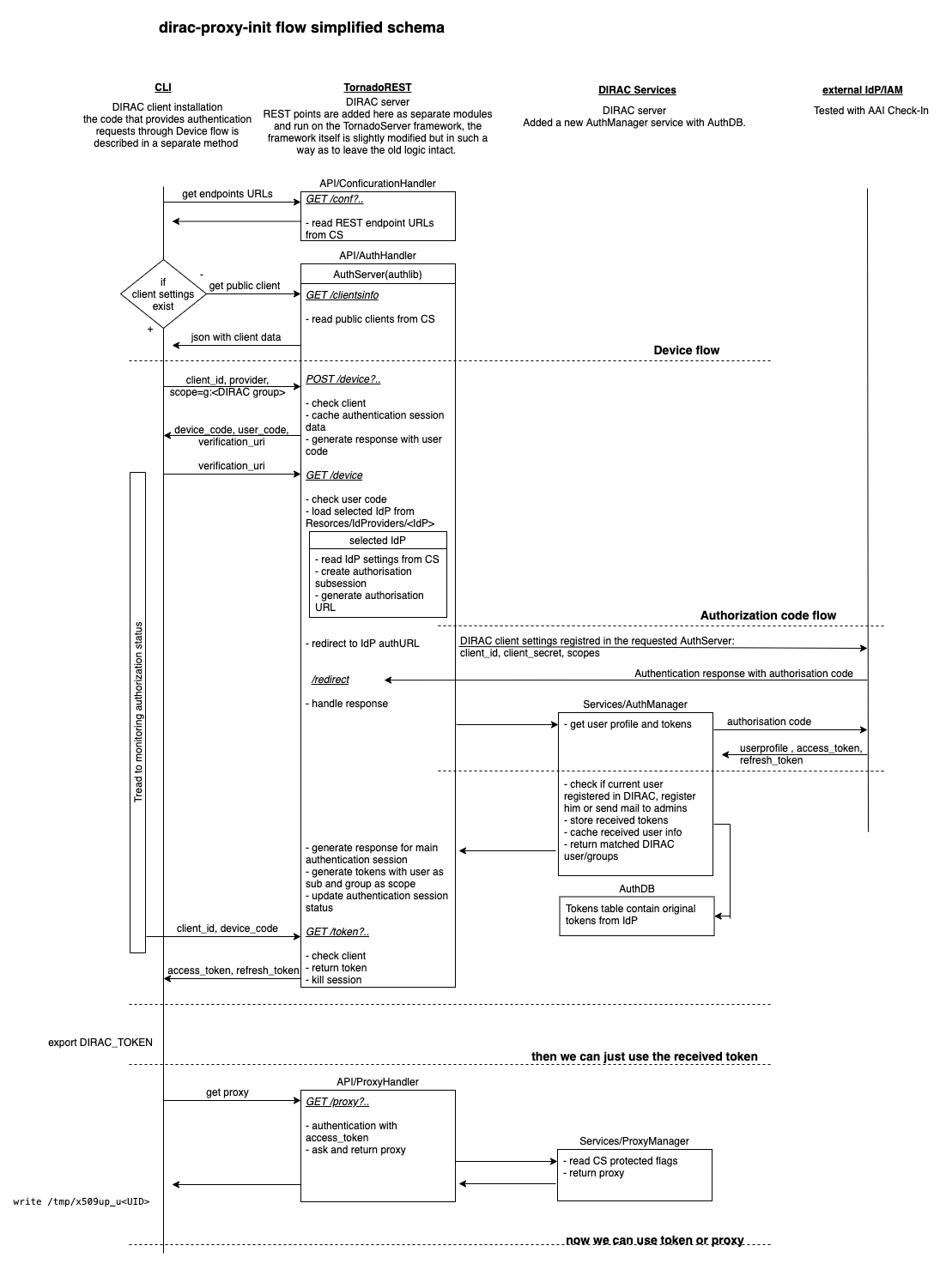
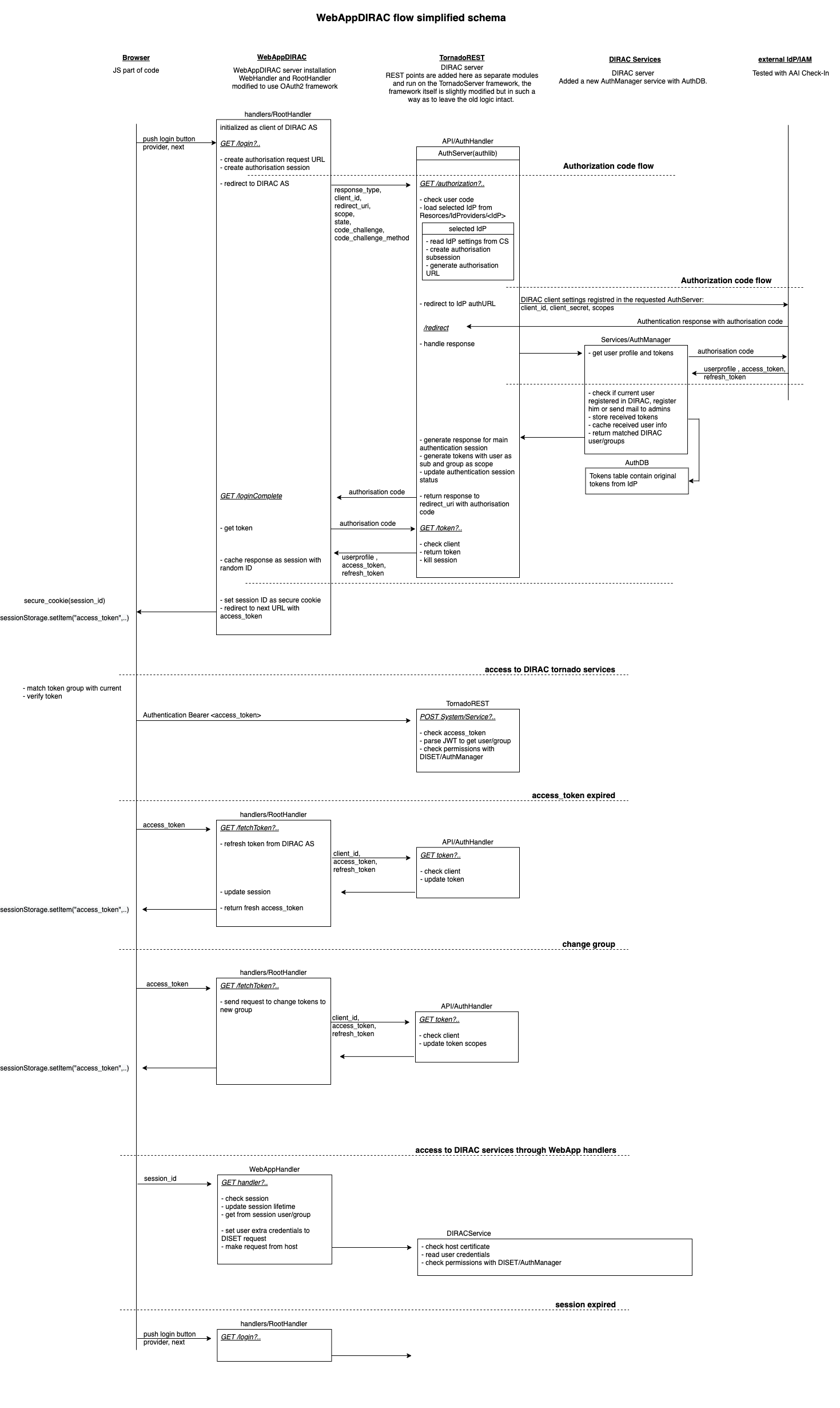
Following our discussion last Friday, what I would like to see is a graphic representation of the various components and how they interact with each other, for the different scenario. For example the whole exchange of what happens when someone does |

|
Here is a simple diagram where there are basic things. I still work on other more detail schema. |
 TaykYoku
force-pushed
the
v7r2-pre33_tokens
branch
from
TaykYoku
force-pushed
the
v7r2-pre33_tokens
branch
from
5f37085 to
a8d6687
Compare
 fstagni
left a comment
fstagni
left a comment
fstagni
left a comment
There was a problem hiding this comment.
This is a partial review. I did not yet have a proper study at many of the important changes that have been done here.
| Thare are present two important imports, that provide caching data:: | ||
|
|
||
| * :mod:`ProxyManagerData <FrameworkSystem.Client.ProxyManagerData>` caches information from VOMS | ||
| * :mod:`AuthManagerData <FrameworkSystem.Client.AuthManagerData>` caches information from IdPs |
There was a problem hiding this comment.
This module, as well as all the other modules in ConfigurationSystem/Client/Helpers/ should IMO be used to only interact with the information found in CS. What you are building here is a "UserIdentity client/discovering tool". I would prefer this is a specific, different module.
There was a problem hiding this comment.
Yes, I agree that the Registry is part of ConfigurationSystem and if I want to use some external source for using by Registry I need sync it with CS sections/options, but such synchronization imposes some additional difficulties, such as a possibility of an error at simultaneous updating with other commit, it is necessary to consider authorship of this or that record, etc.
Another option is to create, as you say, a separate module and use the Registry there. In this case, need to review all the code where the Registry is used and most likely replace it almost everywhere with a newly created module.
I can move the Registry to DIRAC/Core/?
| authorizeBySession(credDict, logObj=self.log) | ||
| else: | ||
| authorizeByCertificate(credDict, logObj=self.log) | ||
| return credDict |
There was a problem hiding this comment.
While there are only a few modifications to this file, I think we agreed to not develop dip (so, DISET) any further.
There was a problem hiding this comment.
unfortunately these changes were made long before this decision, I will probably review these changes again to see if they can be avoided
| csSection = PathFinder.getServiceSection('Framework/ProxyManager') | ||
| if requestedUsername != credDict['username'] or requestedUserGroup != credDict['group']: | ||
| return S_ERROR("You can't get %s@%s proxy!" % (credDict['username'], credDict['group'])) | ||
| elif not gConfig.getValue('%s/downloadablePersonalProxy' % csSection, False): |
There was a problem hiding this comment.
This is not the right way to get service-specific options. But anyway, what's the rationale for this option?
There was a problem hiding this comment.
downloadablePersonalProxy flag that allow/deny to download personal proxy from the Proxy RESTful endpoint(DIRAC/FrameworkSystem/API/ProxyHandler.py) using authorisation with tokens.
I agree that this check is out of place here:
moved this flag in configuration from Services/ProxyManager to APIs/Proxy, as it decides before sending a request to the ProxyManager service and moved everything related to this from the ProxyMnager service to the Proxy RESTful endpoint. Added the isDownloadablePersonalProxy method to DIRAC/ConfigurationSystem/Client/Utilities.py to read this flag.
TaykYoku
force-pushed
the
v7r2-pre33_tokens
branch
from
0270fc3 to
8ecaf81
Compare
 TaykYoku
force-pushed
the
v7r2-pre33_tokens
branch
from
TaykYoku
force-pushed
the
v7r2-pre33_tokens
branch
from
4091d4c to
37a750a
Compare
|
|
||
|
|
||
| def getDIRACClient(): | ||
| """ Get registred in the configuration DIRAC authentication client |
There was a problem hiding this comment.
registred -> registered (several instances of that)
|
|
||
|
|
||
| def getAuthorisationServerMetadata(): | ||
| """ Get authoraisation server metadata |
There was a problem hiding this comment.
authoraisation -> authorization (and in general, sadly, let's use "Authorization" not "Authorisation" (e.g. name of this method...)
| data['jwks_uri'] = data.get('jwks_uri', data['issuer'] + '/jwk') | ||
| data['token_endpoint'] = data.get('token_endpoint', data['issuer'] + '/token') | ||
| data['userinfo_endpoint'] = data.get('userinfo_endpoint', data['issuer'] + '/userinfo') | ||
| data['registration_endpoint'] = data.get('registration_endpoint', data['issuer'] + '/register') | ||
| data['authorization_endpoint'] = data.get('authorization_endpoint', data['issuer'] + '/authorization') | ||
| data['grant_types_supported'] = data.get('grant_types_supported', [ | ||
| 'code', 'authorization_code', 'urn:ietf:params:oauth:grant-type:device_code', 'refresh_token' | ||
| ]) | ||
| data['response_types_supported'] = data.get('response_types_supported', [ | ||
| 'code', 'device', 'id_token token', 'id_token', 'token' | ||
| ]) | ||
| data['code_challenge_methods_supported'] = data.get('code_challenge_methods_supported', ['S256']) |
There was a problem hiding this comment.
For my info... are these "standards"? Where do they come from?
There was a problem hiding this comment.
Yes, it comes from Authorization Server Metadata.
Endpoints are defined by FrameworkSystem.API.AuthHandler methods.
it will support two types of authorization, DeviceFlow and AuthorizationCode.
| self.__group = tp[1] | ||
| if tp[2]: | ||
| self.__setup = tp[2] | ||
| self.__ID = tp[3] or self.__ID |
There was a problem hiding this comment.
Move this after
self.__setup = tp[2] or self.__setup please
| from __future__ import absolute_import | ||
| from __future__ import division | ||
| from __future__ import print_function | ||
| # $HeadURL$ | ||
| __RCSID__ = "$Id$" |
There was a problem hiding this comment.
...just empty file is fine.
| def __getRPC(self): | ||
| """ Get RPC | ||
| """ | ||
| if not self.rpc: | ||
| from DIRAC.Core.Base.Client import Client | ||
| self.rpc = Client()._getRPC(url="Framework/AuthManager", timeout=10) | ||
| return self.rpc |
There was a problem hiding this comment.
Why not calling directly the client?
There was a problem hiding this comment.
To avoid additional imports that are available in AuthManagerClient. The problem is that AuthManagerData is used by the Registry, and it in turn can be imported anywhere. Therefore, to avoid possible looping, AuthManagerData imports the minimum required.
| servCrash = self.__service.get('crash') | ||
| if servCrash and servCrash[1] > 2: | ||
| return servCrash[0] | ||
| result = self.__getRPC().getIdProfiles(userID) | ||
| # If the AuthManager service is down client will ignore it 1 minute | ||
| if result.get('Errno', 0) == 1112: | ||
| crash = self.__service.get('crash') | ||
| self.__service.add('crash', 60, value=(result, (crash[1] + 1) if crash else 1)) |
There was a problem hiding this comment.
Can you explain what's this about?
There was a problem hiding this comment.
Here AuthManagerData waits for the AuthManager service to "wake up".
If the service does not respond twice, then within a minute the client will return the error without contacting the service. So as not to wait for a timeout every time
| self.updateProfiles(uid, data) | ||
| return result | ||
|
|
||
| def getIDsForDN(self, dn, provider=None): |
There was a problem hiding this comment.
Can we have more than one ID per DN?
There was a problem hiding this comment.
I think this is unlikely, but still possible
| proxyToConnect=proxyToConnect, | ||
| token=token) | ||
| if not getVOMSAttributeForGroup(group): | ||
| gLogger.verbose("No voms attribute assigned to group %s when requested proxy" % group) |
There was a problem hiding this comment.
| gLogger.verbose("No voms attribute assigned to group %s when requested proxy" % group) | |
| gLogger.verbose("No VOMS attribute assigned to group", group) |
| """ ProxyManagerClient has the function to "talk" to the ProxyManager service. Also, when requesting information | ||
| about users, this information is cached in a separate class | ||
| :mod:`ProxyManagerData <FrameworkSystem.Client.ProxyManagerData>`, and is used, in the Registry for example, | ||
| to reduce the number of requests to the server part |
There was a problem hiding this comment.
The signatures of the methods in this client largely changed. Given that this is a client, maaaybe it's OK, but not so much.
Other methods were removed, and for these ones do you think that it would be better to use deprecated?
[v7r3] login with tokens (first part of the #5045)

|
@chrisburr That's right, that's what #5149 was created for. |
4 participants


This PR is an updated version of #4650, all comments from the old PR were taken into account here. The main update is the use of
/Core/Tornadothings, documentation is torn from #4650 and will be updated.This PR introduces the AuthN/AuthZ mechanism to DIRAC based on the use of Identity Provider
services using OAuth2/OIDC protocols.
Few remarks about the implementation.
The user AuthN/AuthZ paradigm changes. Before we collected all the necessary user information
in the CS Registry and then used it to identify and authorize client requests. Now we can use
external identity providers dynamically. Each time a user is starting a DIRAC session, the
authentication can be delegated to an external identity provider. If authentication is successful,
then actual user profile information is cached in a dynamic session object which is created
for each active user. This session is used for further identification of user requests. Therefore,
DIRAC CS Registry becomes just one of the possible sources of the user profile information. Other
sources are (Federated) Identity Providers, e.g. Check-In, Indigo AIM, Google, etc, VOMS.
The use of X509 certificates is no more the only way for user identification. Therefore,
certificate DN's are no more the primary user identifiers. Now there can be also user IDs
from various identity providers. Within DIRAC, user name becomes the main, single and unique
user identifier independent on various user identities from different providers. As a consequence,
all the CS options with user identities as values, e.g. pilot user, should be expressed in terms
of user names rather than DNs. For backward compatibility current options in a form of DN are
still accepted but should be replaced eventually.
There can be now DIRAC users that do not have usual personal certificates and will identified
via OAuth2/OIDC mechanism. However, in order to ensure the work of the DISET protocol still based
on the use of X509 certificate proxies, the us of Proxy Provider services is enabled. These
services can create a certificate proxy on demand to be used by users in CLI interfaces and
by DIRAC services for performing operation on the users' behalf. Current solution is DIRAC Proxy
Provider using DIRAC CA certificates to generate user proxies (for the DIRAC internal use only).
Solution using RCauth Proxy Provider service is tested and will be available in later PRs.
Users having usual X509 certificates will continue to use those in a usual way.
Identity Providers and Proxy Providers are added as new types of Resources.
Although this PR introduces new functionalities, the current mechanisms of X509 based user
authentication are still maintained. Installations and users using old good X509 certificates
will continue to work without any changes.
More about the important changes:
There has been implemented
AuthServer(FrameworkSystem/private/authorization/AuthServer.py) using authlib library, it is sewn into theAuthHandlerendpoint essentially simulates activity of an identity provider.This service has been created to accumulate and update user profile information and tokens from Identity providers in
AuthDBandAuthManagerDatacache.Has been modified to work with user identification from Identity Providers that must be registred in CFG, just like DNs.
AuthManager(authorizeBySessionmethod)ThreadConfigRequestHandlerBaseClientTornadoBaseClientHas been slightly modified to use it for WebApp and REST APIs.
HandlerManagercan collects endpoints and portalTornadoRESTfor the REST handlersBaseRequestHandlerclass containing the main code forTornadoRESTandTornadoService, where has been added authentication with OAuth tokensThis project requires a REST interface, so some REST APIs were transferred from the RESTDIRAC project and integrated with the
TornadoServerframework ([v7r2] HTTPs services within DIRAC #4677):src/DIRAC/FrameworkSystem/API/AuthHandler.pysrc/DIRAC/FrameworkSystem/API/ProxyHandler.pysrc/DIRAC/ConfigurationSystem/API/ConfigurationHandler.pyRegistry:
Since this project is associated with dynamic data (user information can be updated), it is decided to use the cache for its temporary accumulation:
ProxyManagerServicehas been a little modified to collect VOMS user data.ProxyManagerData-- VOMS information dataAuthManagerData-- identity providers information dataResources:
IdProviderto describe identity providersOAuth2IdProvider-- provide OAuth2 authenticationOAuth2ProxyProvider-- provide the proxy generation with OAuth2 authentication(e.g.: RCAuth)Third-party packages are required:
BEGINRELEASENOTES
NEW: Multiple changes to provide OAuth2/OIDC user AuthN/AuthZ and OAuth session management.
CHANGE: multiple changes to use username instead of DN where applicable.
Changes affect the following Systems: Transformation, Configuration, DataManagement, Framework, RequestManagement, WorkloadManagement. Also tests, Core, Interfaces, Resources.
*ConfigurationSystem
NEW: Registry - use cached data from the AuthManager and ProxyManager clients, modify methods in new logic context
FIX: Resources - split difficult method
FIX: Utilities - fix method name and path
NEW: Add REST API
*Core
NEW: Move the WebApp "core part" to the DIRAC, try to use existing tornado framework
NEW: Add DB version
NEW: DictCache - add getDict method
CHANGE: AuthManager - split authorization logic, fix test
CHANGE: RequestHandler - fill credDict by AuthManager methods
CHANGE: align with the PR changes, use ID as IdP user ID in DISET transport flow
*FrameworkSystem
NEW: Add AuthManager service, DB, client and client with caching IdP information data, REST API
NEW: ProxyManager - split client part to parts with VOMS information cache data and simple client, add REST API
CHANGE: ProxyManager - modify to use user/group in requests
NEW: dirac-proxy-init - able to use authentication flow through the Identity providers
NEW: halo - new class to use spinners for waiting process, for ex. waiting authentication
*RequestManagementSystem
CHANGE: Request - add owner parameter, use AuthManager methods
CHANGE: align with the PR changes
*WorkloadManagementSystem
NEW: Add User/pilotUser parameter
CHANGE: align with the PR changes
*TransformationSystem
CHANGE: align with the PR changes
*DataManagementSystem
CHANGE: align with the PR changes
*Resources
NEW: add OAuth identity and proxy providers
CHANGE: align with the PR changes
*Interfaces
CHANGE: align with the PR changes
*tests
CHANGE: align with the PR changes
ENDRELEASENOTES